Sila Sheepdog
The breed standard
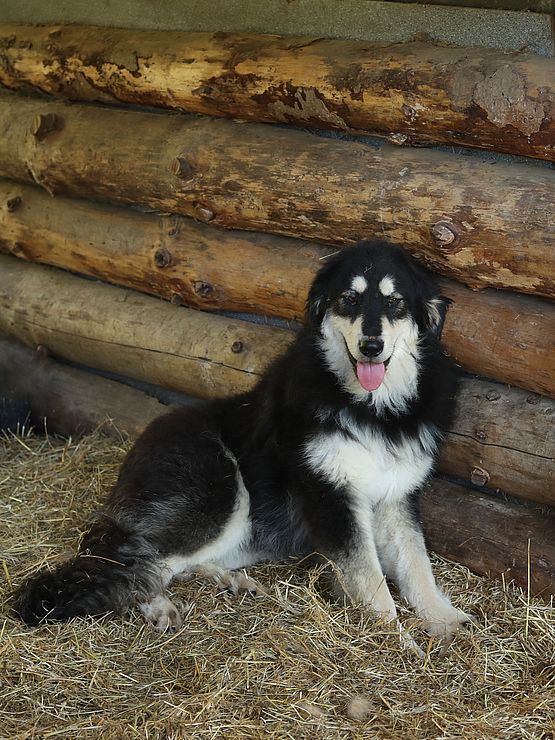
Provisional Standard of the Sila Sheepdog drawn up by the Technical Committee of the Sila Shepherd Club (deposited with the ENCI) ORIGIN: Italy
UTILIZATION:
Sheepdog used primarily for the protection of flocks, but also of property in general.
F.C.I. Classification:
Group 1 - Sheepdogs and Cattle Dogs (excluding Swiss Cattle Dogs)
Section 1 - Sheepdogs without working trial
BRIEF HISTORICAL NOTES:
The Sila Sheepdog has been bred since time immemorial in the mountainous regions of the Calabrian Apennines. The breed took its name from the Sila Plateau, where it is most widespread. Its origins can be traced to the herding dogs that arrived in Calabria following the Indo-European peoples and to the herding dogs that followed the Greek populations during the subsequent colonization of the Sila Plateau.
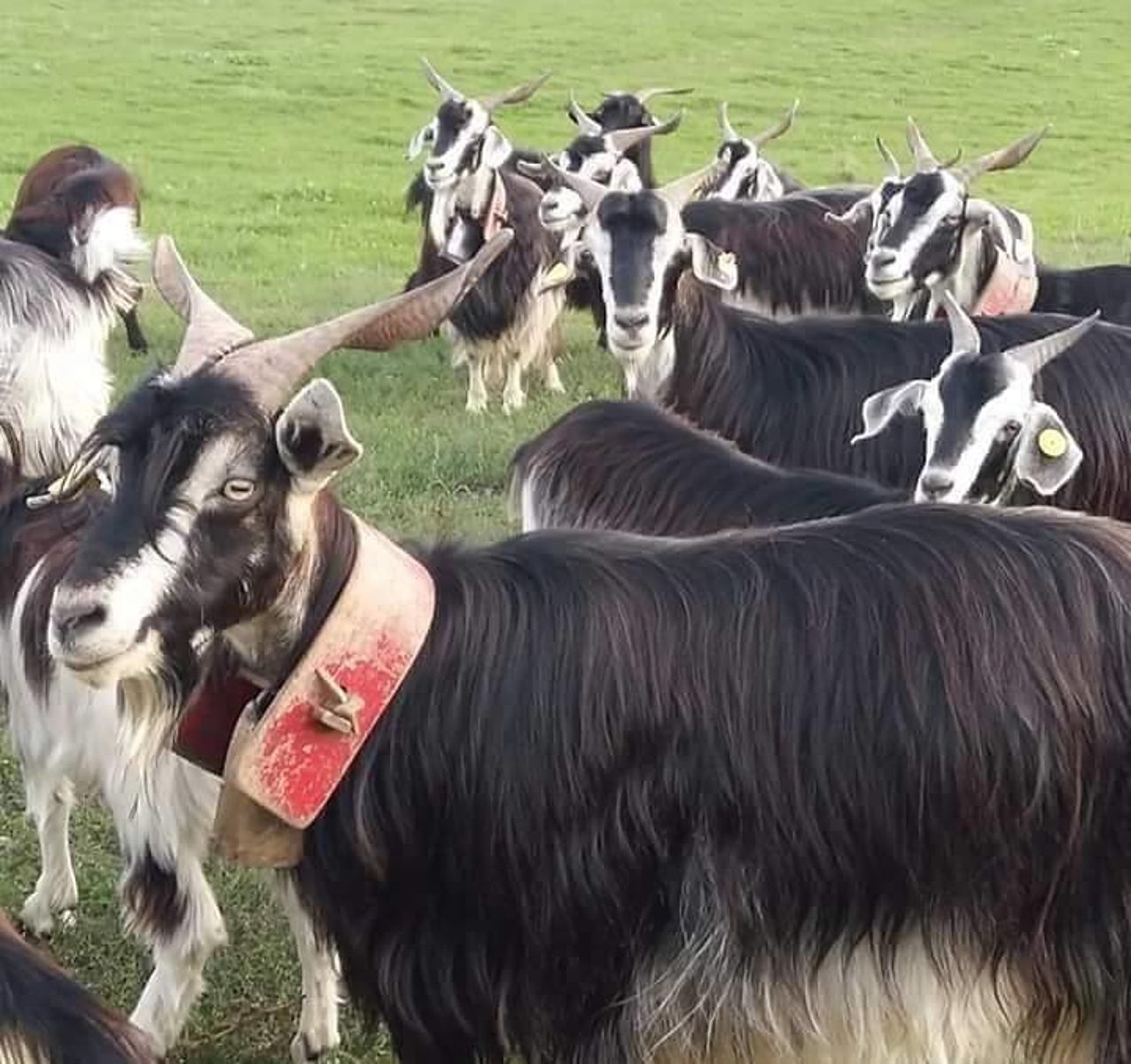
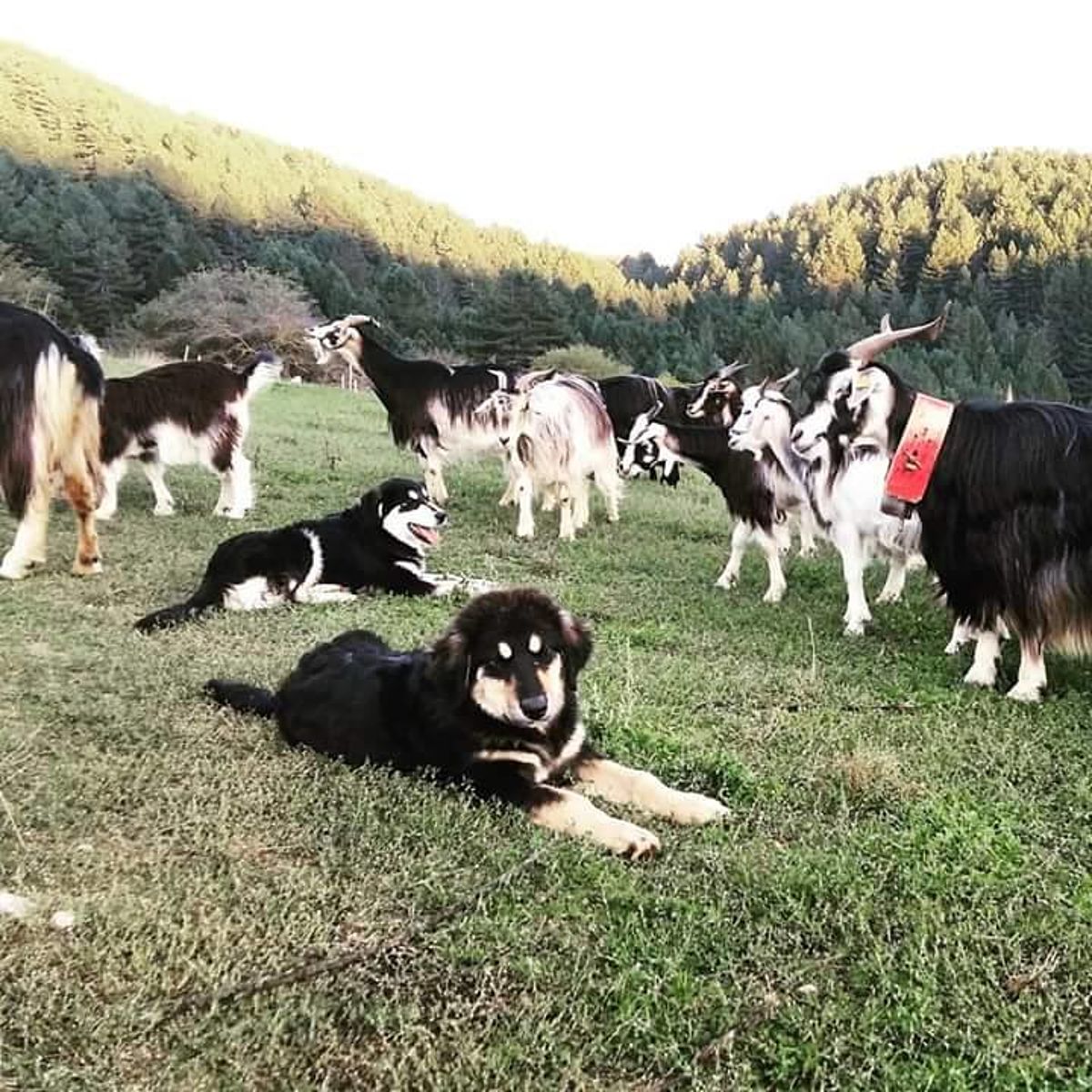
The original type of the breed was developed and maintained thanks to the rugged and impenetrable terrain of the Calabrian Apennines, where the Sila Sheepdog has always been used to protect livestock, especially goats, from wolves.
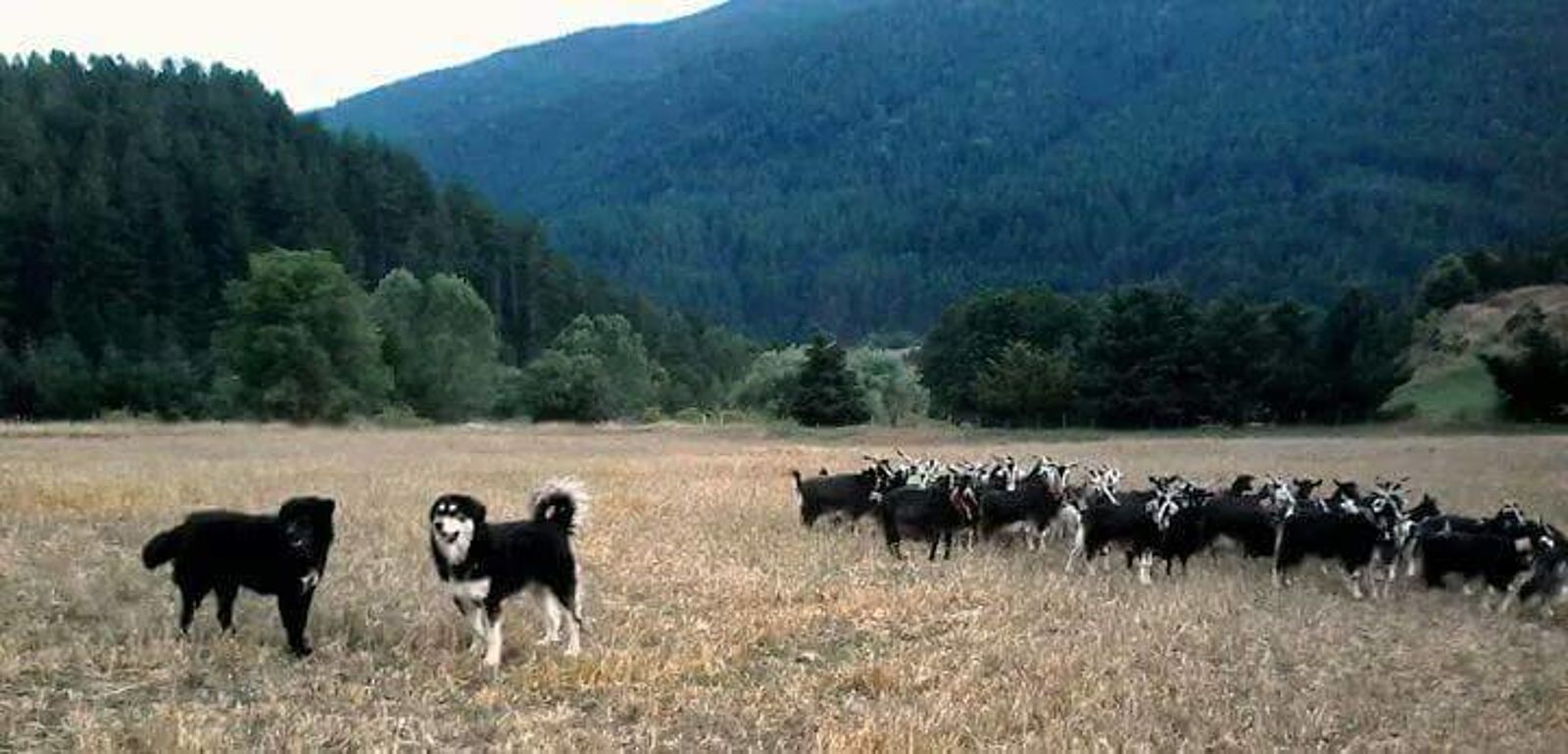

1. General appearance of the dog
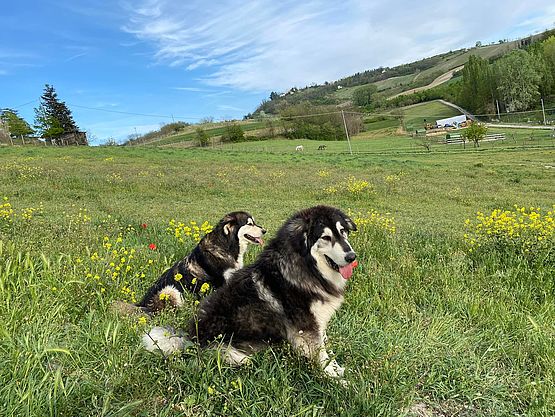
Coppia dicavi di mandria calabresi
The Sila Sheepdog has a mesomorphic conformation, harmoniously built, large and vigorous, with strong bones and a powerful muscular system, while always displaying great agility.
The dog should never appear stocky or low-limbed. The body is rectangular. Sexual dimorphism is well-defined. The thick, long coat, of a semi-glassy consistency, emphasizes the animal's power.
2. Important proportions
The total length of the head is proportionate to the height at the withers.
The length of the muzzle is slightly less than the length of the skull.
The width of the skull is almost equal to its length.
The length of the forelimb (from the elbow to the ground) measures 50-52% of the height at the withers.
3. Behavior and character
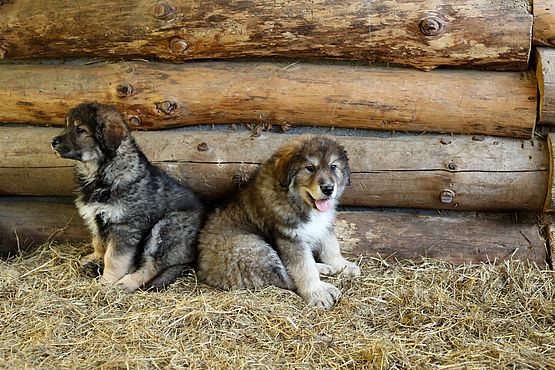
Historically used to protect flocks from wolf attacks, the Sila Shepherd is adept at living without suffering in extreme environments, despite the very meager diet shepherds feed their dogs. This natural selection has given it great hardiness, resulting in excellent robustness and disease resistance.
It is a fearless and tireless guardian, a steadfast and incorruptible defender of the property entrusted to it, but in the presence of the shepherd/owner, to whom it has unconditional devotion, it is apt to socialize even with strangers.
Lively and tirelessly, it learns commands very easily. It is a perfect playmate for children, towards whom it naturally assumes a compliant and submissive attitude. It demonstrates a remarkable ability to adapt to any new environment. It is an excellent climber.
4. Head
The head is broad and massive. Seen from above, it resembles a truncated cone with a broad base.
Cranial Region
The skull is almost as long as the head itself. The lateral and frontal profiles are slightly convex, so the skull should never appear square. The superciliary ridges are only slightly accentuated, as are the frontal furrow and the occipital crest. The craniofacial axes are slightly divergent.
Stop
The fronto-nasal depression is barely marked.
Facial Region
Muzzle: Broad and deep at the root, tapering slightly towards the nose. Its lateral surfaces are therefore slightly convergent, but the front of the muzzle remains painted. Cheeks are only moderately pronounced. The suborbital region is slightly chiseled due to the skin, which in that area should be thin and close-fitting.
Nose: Large, with well-open nostrils, black for all coats.
Lips: Moderately thick, well-drawn, and pigmented black. The corner of the lips is not very pronounced, so the lower lateral profile is determined by the lower jaw.
Jaw: Broad and strong.
Teeth: White and healthy. The incisors are close together and set in a single line. Scissor bite.
Eyes: The eyes are semi-laterally positioned, not large in relation to the size of the head, and are neither protruding nor deep-set. The eyelids are almond-shaped. The eyelids are well-fitting and pigmented black. The iris varies from ochre to dark brown. The gaze is frank and attentive.
Ears: Not large in relation to the size of the head. Set above the zygomatic arch, they are V-shaped with a slightly rounded tip. They are carried pendant but mobile, and lie close to the cheeks.
5. Neck
Medium length, strong and muscular. Its upper profile is slightly trimmed. Always free of dewlap, it is covered with long, thick hair that forms a ruff, particularly noticeable in males.
6. Loin
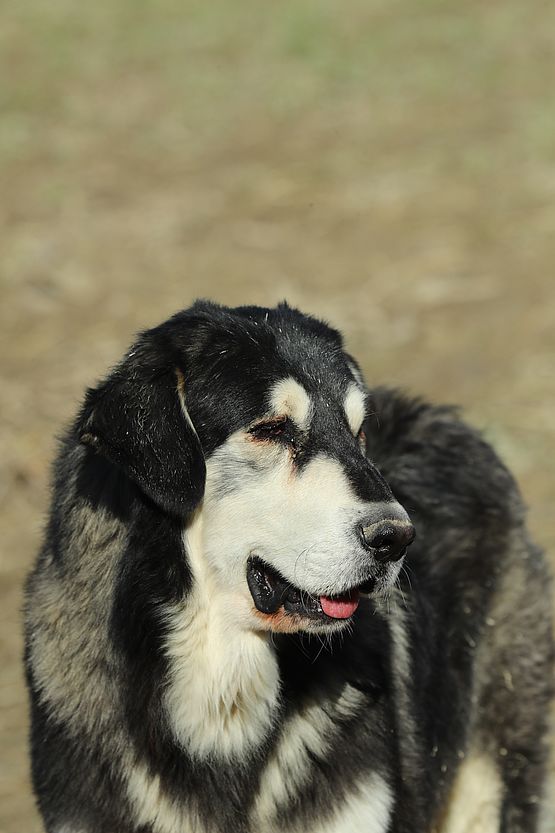
The total length of the body slightly exceeds the height at the withers.
Withers: Moderately raised above the line of the back, it is broad due to the distance between the points of the shoulder blades and long.
Back: Moderately broad, muscular, and solid, with a straight profile.
Loins: Short, broad, and muscular.
Croup: Long, sloping, broad, and muscular.
Chest: Deep, almost reaching the elbows. The ribs are well-sprung and oblique, never barrel-shaped, with well-spaced intercostal spaces.
Belly: The sternoventral profile slopes gently toward the abdomen.
7. Tail
Set relatively low, when standing it reaches the hock or beyond. When excited it is raised like a scimitar, even above the line of the back, but never curled. It is well furnished with thick hair.
8. Forelimbs
The forelimbs are well-muscled and well-boned. Seen from the front, they are straight, parallel, and set well apart, in proportion to the width of the chest.
Shoulder: The shoulder is long, sloping, and muscular.
Upper arm: Long, well-connected to the body, and well-muscled.
Elbows: They should be parallel to the median plane of the body, turning neither in nor out.
Forearm: Straight, well-boned, and round in cross-section. Covered with longer hair on the rear.
Carpus (Wrist): Strong, lean, and of good thickness.
Pastern: Not long, slightly bent in profile, but never showing signs of weakness.
Feet: Large, rounded, with tightly closed toes covered with short, dense hair. Nails strong and pigmented black.
9. Hind limbs
Seen from behind, the hindquarters are straight and parallel. Seen from the side, they are sufficiently angulated.
Thigh: Long, broad, and muscular, with a slightly convex hindquarters.
Knee: Must be perfectly perpendicular, like the entire hindquarters, turning neither in nor out.
Lower thigh: The anatomical base (tibia) is long. With strong bone and lean musculature. The groove in the lower leg is clearly visible.
Hock: Strong and supportive. Firm.
Rear pastern: Only moderately long, robust, lean, and broad. The presence of dewclaws, single or double, is tolerated.
Feet: Like the foreleg, but slightly more oval with moderately arched toes.
10. Dog's gait
Free and fluid trot, with a long stride and a firm topline. It should always give the impression of an agile dog.
11. Skin
Moderately thick, close-fitting to the body in all regions. The skin on the face is thinner. There are no folds or wrinkles. The pigment of the mucous membranes, sclera, and pads is black.
12. Coat
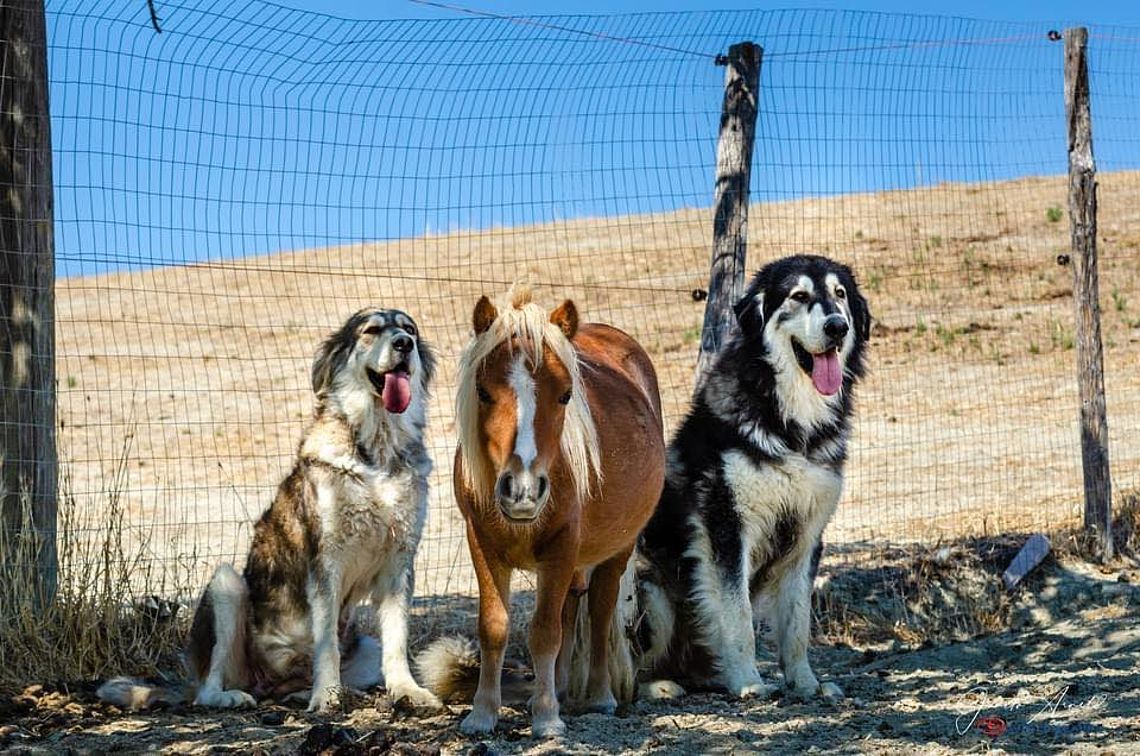
Coat
Straight, very abundant, coarse, and only moderately close-fitting. Slight waviness is tolerated. The guard hair is shorter on the muzzle, skull, ears, and front edges of the limbs, while the rest of the body should be no less than 6 cm long, forming a mane around the neck (more abundant in males) and limited fringes on the back edges of the limbs. The texture is semi-vitreous. In winter, the undercoat is abundant.
Color
Permitted colors are those similar to the coats of native goat breeds raised on the Sila Plateau.
Black: Pure black with a black undercoat and a small white patch on the chest. White patches may also be present on the toes and the tip of the tail.
Black and Tan: Pure black with a black undercoat and tan markings typical of black and tan coats, ranging from very light cream (jelino) to intense fawn. No white markings are permitted in this coat except for a small blaze on the forehead.
Sable: Fawn to gray in color, more or less intense, streaked with black. White markings may be present on the chest, toes, and tip of the tail.
13. Size and weight
Height at the withers
Males: 60 cm to 68 cm, with a tolerance of 2 cm for the maximum limit.
Females: 58 cm to 66 cm, with a tolerance of 2 cm for the maximum limit.
Weight
Males: 40 to 50 kg
Females: 35 to 45 kg
Males must have both testicles appearing normal and fully descended into the scrotum.
14. Defects
Pending the establishment of an Open Stud Book by the ENCI, only the following faults are currently being considered, which will exclude those found to be carriers of them from the section.
- Monorchidism.
- Cryptorchidism.
- Prognathism.
- Erect or semi-erect ears.
- Size below the minimum size.
- Excessively diffuse white color beyond the established limits.
- Curly coat.
- Coat too short.