
The first references
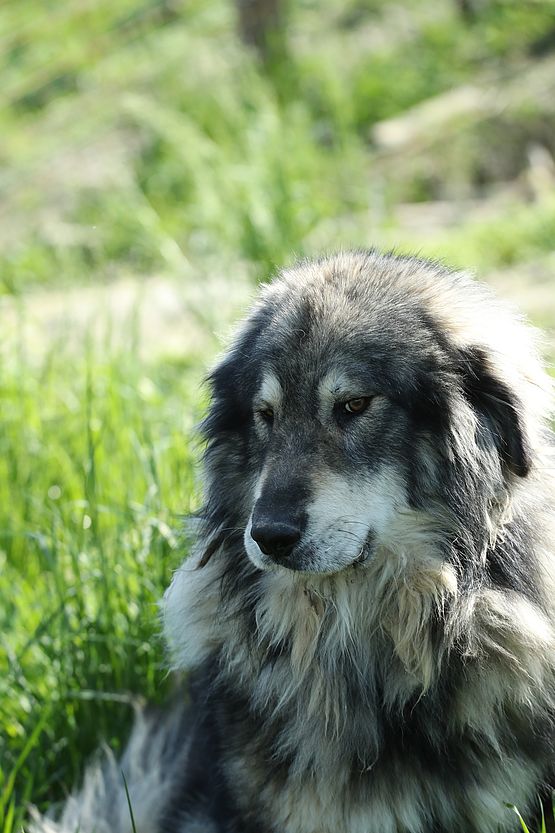
The origins of the Pastore della Sila are ancient and well documented. Already mentioned in the nineteenth century by travelers of the Grand Tour, it was first described scientifically in 1906 by the natural historian Armando Lucifero in the essay Mammalia Calabra. Lucifero speaks of a large dog, comparable to the Newfoundland, with long and slightly wavy hair, a plumed tail, a pointed muzzle, and drooping ears. The coat is brown-fawn on the upper part and lighter, sometimes white, on the lower part, confirming the morphological identity and the long history of this breed connected to Calabrian pastoralism.
In the 1950s, in a rural Italy still deeply tied to pastoral life, Count Giovanni Bonatti—a passionate dog enthusiast and careful researcher—turned his attention to a breed that was then little known but of great functional value: the Calabrian shepherd dog. His contribution was not only theoretical but also concrete and engaged, supporting the path of study and selection that would find full expression starting in the 1970s thanks to the fieldwork of Dr. Ferdinando Sala.
In his article Il pecoraio calabrese, Bonatti offers a clear and profound portrait of this dog, defining it without hesitation as a true “zootechnical reality”, the result of centuries of adaptation to the land and to human needs. With words full of respect and sensitivity, he recognizes in the selection work carried out by Dr. Sala not only scientific rigor but also a rare dedication, capable of combining expertise, passion, and respect for the identity of the breed. A recognition that still today represents a valuable testimony to the birth of a conscious and far-sighted selective breeding path.
The Calabrian shepherd
newspaper article by Giovanni Bonatti
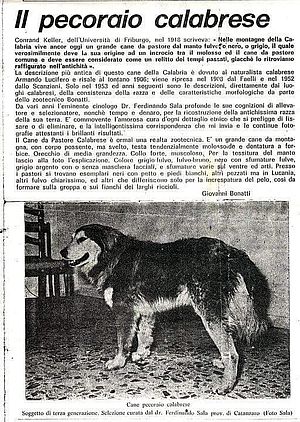
Storico articolo sul cane da pastore della Sila, pastore silano, il Pecoraro calabrese.
Conrand Keller of the University of Freiburg wrote in 1918: "In the mountains of Calabria, a large sheepdog with a fawn, black, or gray coat still lives today. It likely originated from a cross between the Molosser and the common sheepdog. It must be considered a relic of times gone by, since it is depicted in ancient times."
The oldest description of this Calabrian dog is by the Calabrian naturalist Armando Lucifero, dating back to 1906; it was revisited in 1908 by Faelli and in 1952 by Scanziani. Only in 1953 and the following years were descriptions of the breed's composition and morphological characteristics made directly from Calabria by zootechnician Bonati.
For several years, the eminent cynologist Dr. Ferdinando Sala has dedicated his knowledge as a breeder and selector, as well as his time and money, to the reconstruction of his country's ancient breed. His loving attention to every ethnic detail, whether fixed or eliminated, is touching, as are the highly intelligent correspondence he sends me and the constant photographs attesting to the brilliant results.
The Calabrese Sheepdog is now a livestock reality. It is a large mountain dog, with a powerful yet agile body, a molosser-like head, and a scissor bite. Its ears are medium-sized. Its neck is strong and muscular. I'll leave the photo to explain the texture of its coat. Colors range from gray-tawny, fawn-brown, black with fawn highlights, silver-gray with or without a facial mask, and various shades on the belly and limbs. Among shepherds, some are black with a white chest and feet, others are piebald but in Lucrania, others are very light fawn, and others differ only in the curling of their fur, forming large curls on the rump and flanks.
Giovanni Bonatti